Cover: AI-generated editorial illustration.
When you do not know someone’s hobby collection, choose a gift that fits a confirmed interest without depending on an unknown scale, variant, tool system, or missing part. The strongest options are an exact wish-list item, a consumable they already use, an accessory with dimensions you have checked, or a shared hobby experience they would enjoy.
The trick is to learn one useful detail before buying. “They like trains” leaves hundreds of ways to choose the wrong thing. “They model a particular railroad in HO scale and asked for this exact building kit” gives you something dependable to work with.
In this guide
- Find out what they enjoy doing
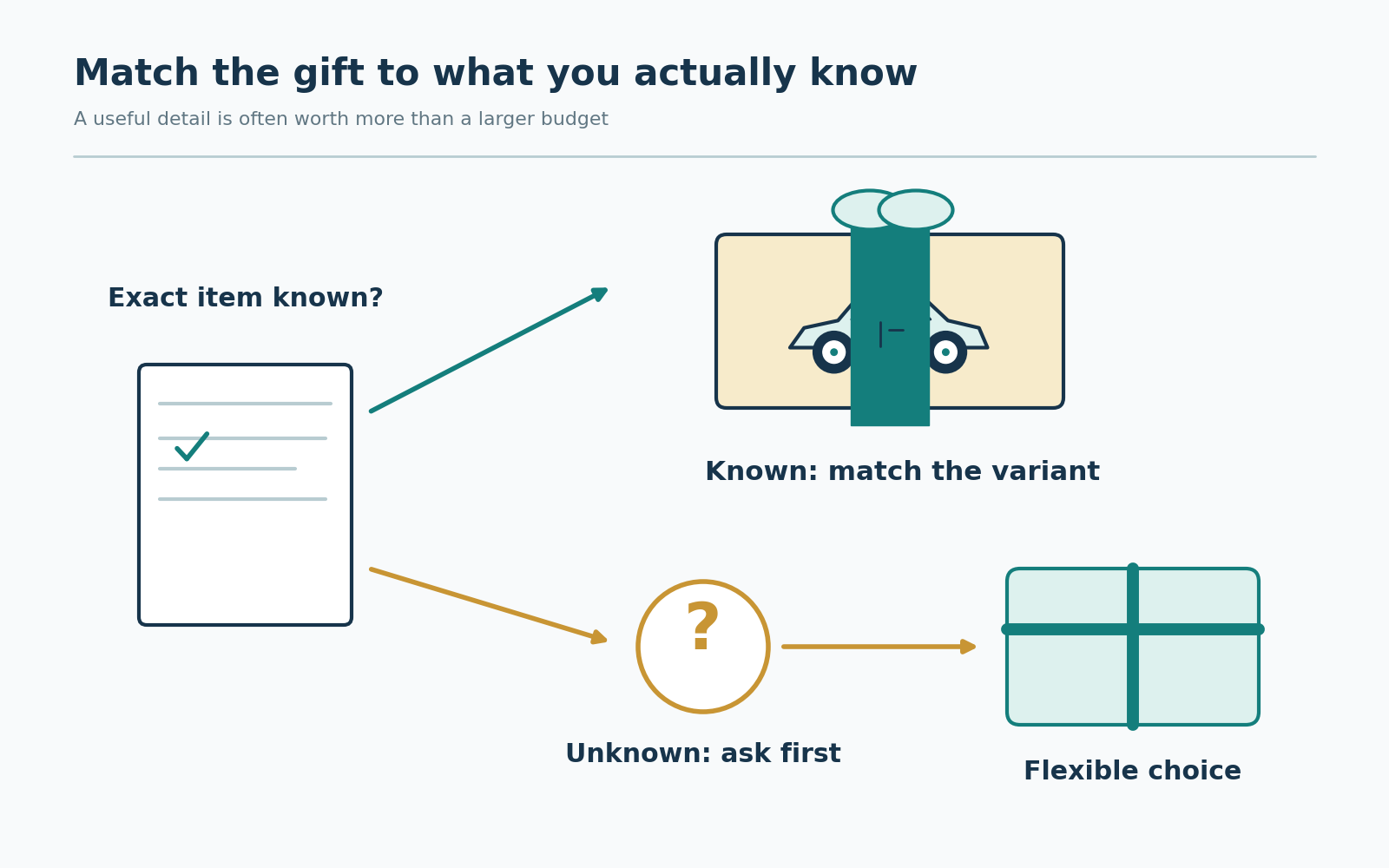
- Use a confidence ladder
- For collectors, exact identity matters
- For builders, match the project they want
- Consumables can work when the match is exact
- Useful accessories still need measurements
- Give an experience that fits their schedule
- Make a flexible gift feel personal
- Check the order before handing over the gift
- Frequently asked questions
Find out what they enjoy doing
People can share a hobby label while enjoying very different activities. One car enthusiast collects sealed diecast releases, another customizes loose cars, and another builds large plastic kits. A gift that suits one may create extra work or storage problems for the others.
Ask about the activity in a natural way: “What are you working on next?” or “Which part of the hobby have you been enjoying lately?” Their answer can tell you more than a photograph of a crowded shelf.
If the gift is a surprise, ask someone who knows the collection to confirm an exact item or need. A useful answer includes a model number, product link, size, or photograph of a label. “Anything from that brand” is still a broad guess.
Use a confidence ladder
| What you know | Good direction | What still needs checking |
|---|---|---|
| An exact item on a current wish list | Buy that exact item | Edition, size, variant, quantity, and whether someone else bought it |
| A consumable they repeatedly use | Replace the same product | Full product code, finish, compatibility, and storage needs |
| A specific display or workspace problem | Choose an accessory for that problem | Measurements, installation, and personal preferences |
| Their hobby but no collection details | A flexible gift or an agreed shared outing | Whether they use the retailer or want the experience |
| Only a vague interest | Ask one focused question before buying | Whether they collect, build, paint, race, restore, or simply admire the subject |
Moving up this ladder is usually more valuable than increasing the budget. An accurately chosen small item can be more useful than a costly kit that does not fit their interests or available time.
For collectors, exact identity matters
Collectors may care about details that are easy to miss: a particular release, paint scheme, wheel type, driver number, packaging style, or manufacturer reference. Two listings can show the same full-size vehicle while representing different collectibles.
When you have an exact request, match the maker, product number, scale, visible decoration, and packaging. Read whether the listing contains one item, an assortment, or a complete set. Do not assume a photograph of several models means every pictured model is included.
Preserve original packaging and keep the receipt. Unless the recipient specifically wants a loose example, let them decide whether to open it. If you are considering a used collectible, confirm its condition and completeness instead of relying on “rare” or “collector’s item” in the title.
LootBandit’s diecast car buying guide and model train buying guide provide practical identity checks for two common gift categories.
For builders, match the project they want
A model kit is also a commitment of bench space, supplies, and time. A builder who likes weekend projects may not want an intricate kit with extensive finishing work. An experienced builder may already own the basic tool bundle that looks useful to a newcomer.
Check the subject and scale first, then the kit’s assembly requirements. Read the maker’s description of what is included and what must be supplied separately. Do not assume a box includes paint, cement, cutters, or every finishing material shown in its artwork.
If the recipient has named a kit, keep the choice exact. An alternative version may have different markings, parts, or construction. If they have not named one, choose together or ask for two or three acceptable options so the final choice can still be a surprise.
Our plastic model kit buying guide helps compare scale, included parts, and build requirements before ordering.
Consumables can work when the match is exact
Paint, sanding supplies, blades, brushes, and adhesives can be thoughtful gifts when you know the products the person uses. Photograph the label or request the exact reference. A familiar brand name by itself does not establish the paint type, color, finish, or suitable thinner.
Avoid improvising a “complete paint system” from unrelated products. The U.S. Consumer Product Safety Commission’s Art and Craft Safety Guide emphasizes choosing suitable materials and following their labeling and handling directions. For a gift, keeping the original labeled packaging also gives the recipient the information they need.
Think about quantity. A refill of a heavily used product may be welcome; a large collection of unfamiliar materials can become clutter. If the recipient has carefully chosen their brushes or tools, an exact replacement is a safer bet than a surprise “upgrade.”
Useful accessories still need measurements
Storage and display gifts are appealing because they do not duplicate a particular model. They can still be the wrong size. A paint rack needs to fit the actual bottles. A display case needs to clear the whole model and base. A desk lamp needs a suitable mounting position and enough room to move.
Look for the problem before choosing the product. “They have nowhere to put the current project tray” points toward a measured storage solution. “They own many miniatures” does not prove they need another organizer.
A build notebook is more flexible, but even that benefits from knowing how the person works. Some builders prefer a small paper notebook beside the bench; others keep digital notes and would rather receive supplies for their next project. Choose something that supports an existing habit.
Give an experience that fits their schedule
A visit to a hobby show, museum, model railway event, or workshop can be a good gift when the person enjoys that activity. Check the current date, location, access arrangements, and what is included before buying a ticket. Confirm that the recipient is free, or choose a plan that leaves the date open.
Do not volunteer them for a competition, public demonstration, or club membership without knowing they want it. Watching an exhibition and entering a judged show are different experiences.
A shared build session can be simple: agree on a project, clear a suitable table, and make time for it. The gift is the occasion as much as the kit. Avoid making the recipient responsible for teaching everyone or supplying all the materials unless that is the agreed plan.
Make a flexible gift feel personal
If the collection is specialized and the details remain uncertain, a gift card to a retailer they actually use can be appropriate. Check the retailer’s current terms, currency, redemption method, and any restrictions. Pair it with a note naming the project or interest you want to support.
You can also offer to buy the exact item they choose within an agreed budget. That is particularly useful when a hobby involves compatibility decisions that only the recipient knows. Keep the budget and timing clear so they are not left wondering what the offer covers.
A small related item can add a personal touch, but avoid buying filler simply to make the gift physically larger. A well-written note about why you noticed their hobby is often more meaningful.
Check the order before handing over the gift
- Compare the delivered product number and variant with the intended item.
- Check the outer packaging for obvious damage without unnecessarily opening collectible packaging.
- Keep the receipt and any gift-return information together.
- Leave safety labels, manuals, and small accessory packets with the product.
- Give the recipient room to exchange an unsuitable choice without awkwardness.
For gifts to children, follow the product’s age guidance and warnings rather than assuming that a small model is a toy. Match the project to the child’s skills and the adult help available. The CPSC’s toy safety resources explain why age suitability and small parts deserve attention.
Frequently asked questions
What is a good gift for a hobbyist who seems to own everything?
Find a current project, repeated consumable, or specific inconvenience. An exact refill, a measured accessory, or an experience they want is more dependable than another random collectible.
Is it rude to ask for a wish list?
No. Frame it around getting the details right: “I want to choose something you’ll enjoy using. Could you send me a few exact options?” You can preserve the surprise by choosing from that list.
Are tool sets always useful?
No. A beginner may need a suitable basic set, while an experienced builder may already have preferred tools. Confirm a real gap before buying.
Should I remove the packaging to make the gift look nicer?
Keep the original packaging intact when condition, completeness, labeling, or collectibility may matter. Wrap the box or use an outer gift bag and let the recipient decide what to open.
One exact detail is enough to improve the whole decision. Find out what they want to build, collect, or do next, then choose a gift that makes that next step easier.
Examples for a confirmed gift request
These examples suit different needs. Choose one only after confirming that it fits the recipient’s project, collection, or request.
As an Amazon Associate I earn from qualifying purchases. LootBandit and Muncle Mikes share ownership. Read our disclosure.

Tamiya Basic Tool Set – 74016
A compact basic modeling tool set. Compare its contents with the tools your chosen project requires and what you already own.

Auto World 1:64 Six-Car Interlocking Display Case – AWDC003
One interlocking display case for six 1:64 vehicles. Check the compartment measurements against each model; cars are not included.
Check the exact product, package contents, seller, and current order terms on the retailer’s page.