Cover: AI-generated editorial illustration.
Organize hobby paints by paint system first and color second. Keep each line with its compatible thinner and instructions, then arrange the colors in an order you can repeat. A rainbow shelf is attractive, but it becomes confusing if similar-looking bottles require different products or handling.
You should be able to answer three questions without opening every bottle: what is it, where does it belong, and do I already own it? A modest rack with clear labels can do that better than an elaborate organizer that hides half the collection.
In this guide
- Start with a bottle-by-bottle inventory
- Separate paint systems before sorting colors
- Choose a color order that suits how you work
- Make labels visible from the direction you use
- Use swatches to compare dried paint
- Measure your bottles before choosing storage
- Keep the inventory deliberately simple
- Reset the collection after each project
- Frequently asked questions
- Sources and useful references
Start with a bottle-by-bottle inventory
Take the paints out one tray at a time. Keep labels readable and do not open everything at once. Record the brand, product line, color name, color code, bottle size if relevant, and approximate amount remaining. A simple “full, part-used, low” is sufficient for most hobby benches.
Set aside containers with unreadable labels, damaged closures, or unknown contents. Do not guess what they contain based on smell or color. Consult the product documentation where identification is possible and use the appropriate local disposal route for unwanted material.
Choose the paints for your current project before reorganizing the entire collection. That prevents a useful cleanup from making tonight’s build impossible to start.
Separate paint systems before sorting colors
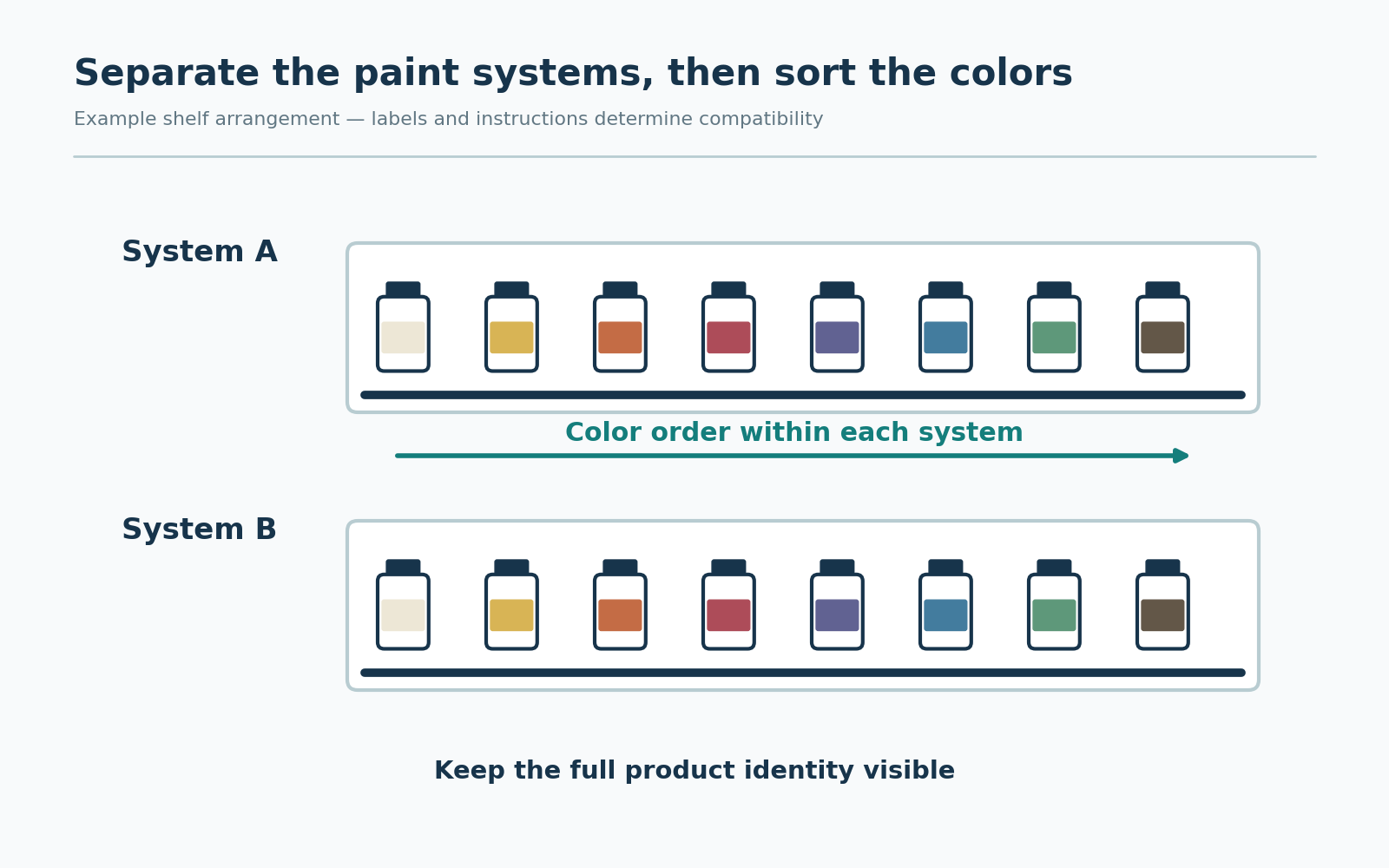
Use the exact product line as the organizing unit. “Acrylic” alone does not tell you which thinner, cleaner, or application method the maker specifies. For example, Tamiya’s XF-69 product information identifies its acrylic-resin paint and names X-20A as a thinning option. Use the instructions for your exact range rather than extending that advice to unrelated paints.
| Group | Useful label | Keep with its record |
|---|---|---|
| Brush-painting range | Brand and complete line name | Recommended thinner, medium, and cleaner |
| Airbrush-oriented range | Brand and line, without assuming universal compatibility | Application and thinning guidance |
| Enamel or lacquer range | Exact system and original hazard information | Safety data and specified handling |
| Primers and clear coats | Product code and finish | Compatible uses and curing instructions |
| Washes, inks, and effect products | Product identity and intended use | Instructions that distinguish them from ordinary paint |
This is an organizational example, not permission to store incompatible materials together. Follow product labels and safety data for storage requirements. Keep aerosols and other products needing specific handling in their proper storage, even when that means they live away from the color rack.
Choose a color order that suits how you work
Within each paint line, use broad families: whites and off-whites, yellows, oranges, reds, purples, blues, greens, browns, grays, and blacks. Put metallics, fluorescent colors, and special effects in clearly marked groups.
If you usually follow kit instructions by paint code, numeric order may be faster than color order. If you mix and select colors by eye, color families are often more convenient. You can combine the two by grouping colors broadly and then sorting codes within each group.
There is no need to force every brown into an exact artistic position. The best order is the one you can restore after a busy session without reconsidering the whole collection.
Make labels visible from the direction you use
For bottles in drawers, put an identification label on the cap or a removable top marker while preserving the original label. For bottles in stepped racks, face the original labels outward. If a bottle has a long name, the product code is often the most compact way to prevent confusion.
Use text as well as color. Two gray swatches can look nearly identical under some lighting, and a small painted dot may not show whether the finish is gloss or matte. A useful label might read “Line A / 047 / dark gray / matte,” with the actual brand and code replacing the example.
Avoid placing new labels over warnings or instructions. Your inventory can shorten the everyday lookup, but it should not remove information you may need later.
Use swatches to compare dried paint
Create small labeled samples on a consistent material and primer. Note whether a clear coat was applied. A swatch is a record of that particular application, so changing the primer or finish can change the comparison.
Keep the swatches in the same order as the bottles or give them matching codes. When choosing colors for a build, place the actual samples together under the same light. A digital color square is convenient for an inventory but should not be treated as a precise paint match.
Save custom mixes separately. Record the products used and a repeatable mixing method, such as measured volumes where practical. “A bit of red in blue” is difficult to reproduce after a long break. Make only what you can store appropriately, with clear identification and the relevant handling information.
Measure your bottles before choosing storage
Check bottle diameter, total height, cap shape, and whether you can lift a bottle out without knocking the one above it. A rack designed for one dropper-bottle size may not suit squat jars or taller bottles.
Leave a little room for the ranges you actually use, rather than buying storage for a collection you might someday own. A small active-paint tray is useful: pull the colors for the current project into it, then return them to their labeled locations when the project is finished.
Do not use improvised food containers for unidentified paint or solvent storage. The CPSC Art and Craft Safety Guide advises keeping materials properly identified and following storage precautions. Place the collection where children and pets cannot reach it.
Keep the inventory deliberately simple
A note, spreadsheet, or small card file can work. Choose one place as the main record so you do not maintain conflicting lists. Include a location code if your paints occupy several drawers.
| Field | Example entry |
|---|---|
| Identity | Brand, line, product code, color name |
| Location | Drawer B, blue group |
| Quantity | One opened bottle, low |
| Project | Reserved for current aircraft build |
| Notes | Swatch 023; finish and primer recorded |
Check this record before shopping, then check the actual bottle if the amount matters. The useful information is whether you have the exact product and enough of it for the planned job.
Reset the collection after each project
Clean closures as directed, close containers securely, and return each product to its assigned place. Record low supplies while you still remember them. Review only the ranges you have used rather than repeatedly auditing every bottle.
If you are simplifying a crowded bench, the hobby tools and supplies buying guide can help you keep the focus on supplies that serve your current work. An organized paint collection should make choosing a color easier, not turn maintenance into the main activity.
Frequently asked questions
Should I arrange paints by brand or by color?
Begin with the exact product line so compatible instructions remain easy to identify, then sort by color or product code within that line. A shared color family is not evidence that two paint systems use the same thinner.
Are painted bottle caps enough for color matching?
They are convenient identifiers, but they do not replace labeled swatches on a known primer and surface. Use text to preserve the paint code and finish, and compare dried samples under consistent lighting.
Do hobby paints all need the same storage temperature?
No universal temperature range should be assumed. Follow the label and current safety data for the exact product, including restrictions involving heat, freezing, sunlight, or incompatible materials.
Sources and useful references
- Tamiya USA: XF-69 acrylic paint product and thinning information
- U.S. CPSC: Art and Craft Safety Guide
Products to compare for this project
As an Amazon Associate I earn from qualifying purchases. LootBandit and Muncle Mikes share ownership. Read our disclosure.

Tamiya Bottled Paint Stand – 74077
A bottled-paint stand to consider after measuring your bottles and available bench space. Check the exact stand dimensions and included accessories.
Check the exact product, package contents, seller, and current order terms on the retailer’s page.


