Cover: AI-generated editorial illustration.
Find a hobby club by starting with the activity you want to share, checking a current directory or local venue, and arranging a visitor session before committing. The best fit is a group whose meetings you can attend and whose members enjoy the part of the hobby that interests you.
A plastic-model club, model railway operating group, RC flying club, and collecting meetup can all be described as hobby clubs, yet they offer very different evenings. Decide whether you want to build alongside people, ask questions, operate equipment, compete, trade, or simply talk about a shared interest. That choice makes your search much more precise.
In this guide
- Start with the activity you want to do
- Use directories as the beginning of the search
- Search locally with a useful combination of words
- Send a short first message
- Visit with one question and a small introduction
- Compare the practical fit after the visit
- What to do when no nearby club fits
- Frequently asked questions
- Sources and further reading
Start with the activity you want to do
Write down two priorities and one practical limit. For example: “I want help learning paint techniques and a relaxed place to show my models; I can travel up to 30 minutes on a weekday.” Someone looking for a layout operating session will need a different shortlist.
Be specific about your subjects without making the search unnecessarily narrow. A general scale-model club may include car, aircraft, armor, ship, and science-fiction builders. You may find excellent help with seam work or photography from someone who builds a completely different subject.
If you are still exploring which branch of the hobby appeals to you, browse our hobby buying guides. Being able to describe the kind of activity you want is more useful at an initial meeting than arriving with a large collection.
Use directories as the beginning of the search
| Interest | Starting point | What to confirm locally |
|---|---|---|
| Plastic and scale modeling | IPMS/USA chapter directory | Current meeting venue, visitor policy, and activities |
| Model railroading | NMRA’s 100% Club Directory | Scale, operating format, membership requirements, and layout access |
| Model rocketry | NAR local clubs and Club Finder | Public participation, current launch schedule, visitor requirements, and site arrangements |
| Other hobby interests | Local hobby shops, libraries, community centers, specialist venues, and event organizers | Whether the group still meets and whom to contact |
A directory entry is a lead, so verify the next meeting with the organizer or a current announcement. Venues, dates, and contact details can change. NMRA’s directory specifically lists its 100% NMRA clubs; it is not a complete list of every model railway group.
NAR distinguishes Public, Organizational, and Private Sections on its local-club information page. Check which kind you have found before assuming you can attend. For other organizations, make the same practical inquiry about visitors and participation.
Search locally with a useful combination of words
Try your town or nearby city with the activity: “scale model club,” “miniature painting night,” “model railroad open house,” “slot car raceway,” or “diecast collectors meetup.” Add neighboring towns when the immediate search is thin. A group may use a regional name even when it meets close to you.
Look for a recent calendar entry, newsletter, meeting report, or organizer response. An attractive website with an old event banner tells you less than a plain page with the next meeting clearly listed. Social groups can help, but confirm whether the online conversation corresponds to an actual local gathering.
Ask a hobby shop what happens regularly. Useful questions include which groups accept visitors, whether there is a build night, and where beginners can observe the activity. An annual show can introduce you to several clubs, but it does not show you what an ordinary meeting feels like.
Send a short first message
Give the organizer enough information to answer easily. You can adapt this:
Hello, I am interested in visiting a meeting. I build plastic car models and am returning to the hobby after a break. Is the next meeting open to visitors? Please let me know the current time and location, whether I should bring a model or tools, and whether there is a visitor fee.
For an operating or flying club, also ask whether you can attend as an observer and whether a beginner session is available. For a family visit, explain the ages attending and ask about supervision and participation. Let the organizer describe the group’s arrangements before you bring equipment.
If there is no reply, try one other current contact route or ask the directory’s regional contact for help. Volunteer-run clubs may take time to respond. A single missed message is inconclusive; repeated difficulty getting basic meeting information is relevant when deciding whether the group will be convenient for you.
Visit with one question and a small introduction
You can arrive with a model, a few photographs, or simply an interest in learning. Ask before setting fragile objects on a display table or taking photos of someone else’s work. If you would like advice, choose a focused question: “How would you approach the seam on this wing root?” is easier to discuss than “What do you think of everything?”
Watch how the group handles newcomers and unfinished work. Do people introduce themselves? Can you ask a basic question comfortably? Is there time for the activity you came to do? Experienced members can have very different styles, so observe the whole meeting rather than judging it by one conversation.
For a build evening, confirm the venue’s rules for blades, solvents, sprays, dust, and powered tools before packing them. Bring only the materials agreed for the session. Our hobby tools guide can help you assemble a compact set once you know what the venue permits.
Compare the practical fit after the visit
| Question | A useful sign | What to ask next |
|---|---|---|
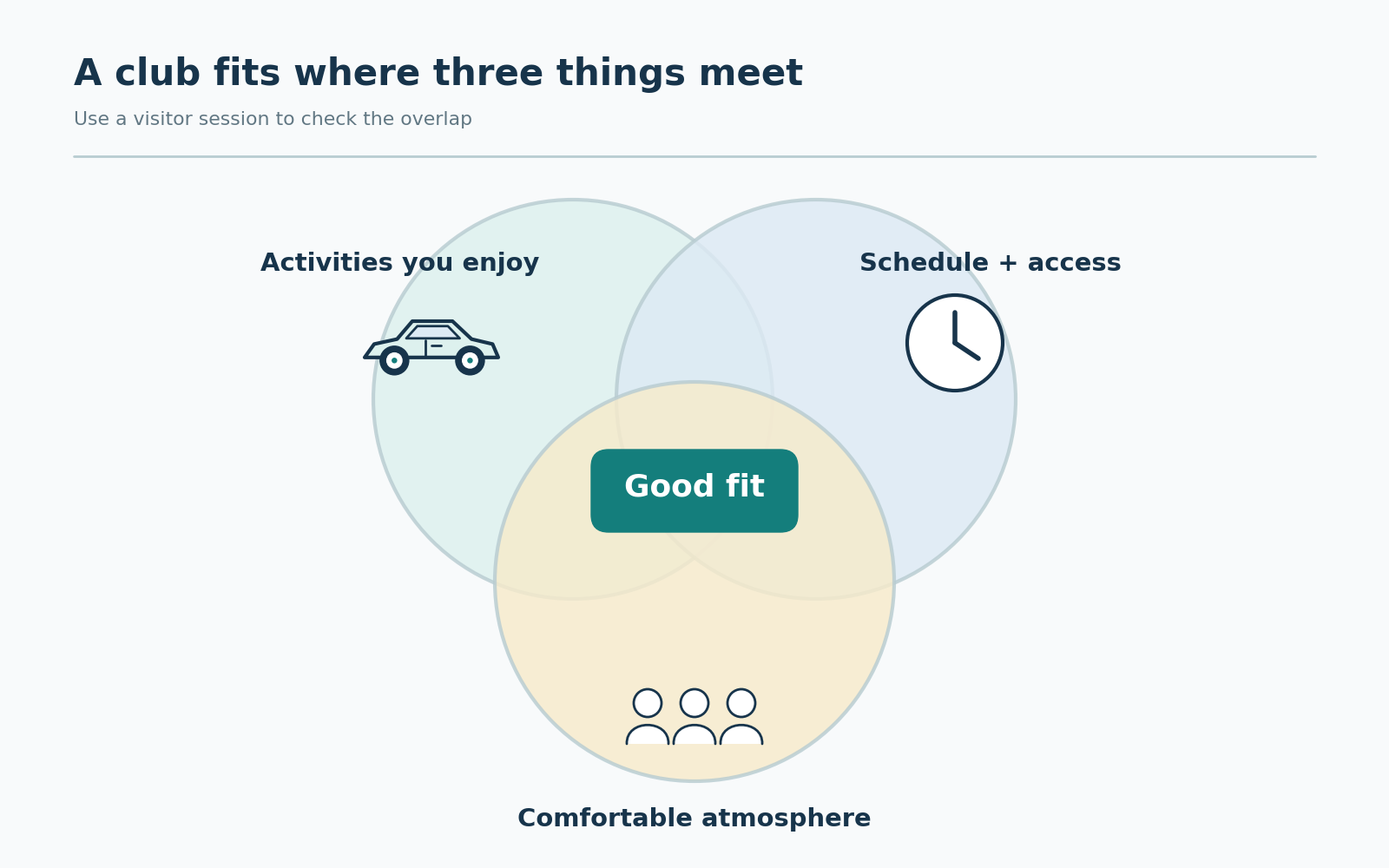
| Does the activity match my goal? | You saw the sort of building, operating, or discussion you want | How often does that activity happen? |
| Can I attend regularly? | Travel, timing, parking, and access work for you | Are the schedule and venue consistent? |
| Is the atmosphere comfortable? | Questions receive useful, respectful answers | Who helps new members get started? |
| Are the costs clear? | Dues and extra charges are explained | Are national memberships, event fees, or equipment contributions separate? |
| Can I participate at my own pace? | The group explains expectations without pressure | Are contests, work sessions, and volunteering optional or required? |
If two clubs look promising, visit each before buying equipment specifically for either one. You may prefer the nearer general-interest group for monthly meetings and a more specialized group for occasional events.
What to do when no nearby club fits
Ask a library, community center, or hobby shop whether a small, hosted session is possible. Start with a simple activity such as a show-and-tell or an instruction-reading evening, then agree on venue rules and a reliable time. A small group with a clear plan can be enough to begin.
You can also combine occasional in-person events with a current online community or a remote session with friends. Confirm that any platform or forum you find is still active before relying on an old recommendation. The important part is a dependable way to exchange progress and useful advice.
Frequently asked questions
Do I need to be an experienced builder to join a hobby club?
Ask the individual group about beginners and visitor sessions. Explain your interests and experience honestly so the organizer can tell you which meetings or activities would suit you.
Should I bring a finished model to my first meeting?
Only if you want to and the organizer says it is appropriate. Photographs or an unfinished project can be useful conversation starters. You can also attend simply to meet people and observe.
Does national membership automatically make me a local club member?
Do not assume that it does. Local groups may have separate enrollment, dues, or participation rules. Ask about both national and local requirements before paying.
How many meetings should I attend before deciding?
One visitor session may answer your questions, but a second can help if the first was an unusual event. Choose based on the ordinary activities, practical schedule, and whether you feel comfortable participating.